Physical Address
304 North Cardinal St.
Dorchester Center, MA 02124
Physical Address
304 North Cardinal St.
Dorchester Center, MA 02124


The enterprise homepage is no longer a place to find information. It is becoming an intelligent operating layer that prepares work, reduces friction, and brings decisions and actions closer to the user. As organizations adopt agent-based systems and orchestration, the homepage evolves from a portal into the front door of enterprise intelligence.
The Homepage Is Changing
For years, the enterprise homepage or intranet has served a familiar role. It has been a starting point, a place for announcements, and a collection of links to other systems. Employees visit briefly, then move on to where work actually happens.
That model is beginning to break down.
As organizations adopt AI more deeply, the homepage is being redefined. It is becoming an intelligent operating layer that prepares work, summarizes what matters, and brings decisions and actions closer to the user. This shift is subtle at first, but its implications are significant.
The change is not driven by interface design alone. It reflects a deeper architectural evolution toward agent-based systems, orchestration, and context-aware experiences.
From Static Dashboards to Context-Aware Experiences
In most large organizations, work still begins with context switching.
Employees open the intranet, then move to a CRM, a project management tool, a knowledge base, and email to fill in gaps. Each system provides part of the picture. Interpretation is left to the individual.
Traditional homepages reflect this reality. They surface information and metrics, but they place the burden of understanding on the user. The homepage becomes a launch point rather than a working surface.
An intelligent homepage changes how information is prepared before it reaches the user.
Instead of presenting raw data or long lists, it synthesizes signals from across systems and presents a concise view of what requires attention. Context is added before the user asks for it. Relevant actions and destinations are surfaced alongside insight, reducing the need to navigate elsewhere.
For a sales leader, the homepage opens with a summary of opportunities that warrant attention. Each item includes recent customer activity, internal engagement, and suggested next steps. Supporting materials and prior communications are immediately available, allowing decisions to be made without assembling context across multiple tools.
For an IT leader, the homepage presents a consolidated view of platform health. Incidents are grouped and prioritized based on impact. Recent changes, affected services, and likely causes are summarized in one place. Remediation paths and escalation options are accessible directly from the same surface.
For a finance executive, the homepage provides a narrative view of financial movement and exceptions. Budget variances, pending approvals, and forecast changes appear with context and projected impact. Attention shifts from reviewing reports to making timely decisions.
For HR leaders, the homepage surfaces patterns related to onboarding, engagement, and workforce risk. Items that require attention are highlighted with relevant organizational context, enabling earlier intervention and follow-up.
Across roles, the experience is consistent in one respect. Information arrives already shaped for decision-making. The homepage reduces searching, navigation, and manual interpretation by presenting a prepared view of work and the actions that follow from it.
This is where the homepage begins to function as an operating layer rather than a portal.
Why This Is Not Just an Integration Problem
It is tempting to view this evolution as the result of better integrations or more connected systems. That framing misses what has fundamentally changed.
Traditional integration patterns focus on moving data between systems. They assume the user will assemble context, determine relevance, and decide what to do next. Even when systems are well integrated, the work of interpretation still sits with the individual.
The intelligent homepage is built on a different pattern.
Instead of connecting systems directly to the user interface, modern architectures introduce agents as intermediaries. These agents understand specific domains, such as customer data, financial processes, operational systems, or internal knowledge. Their role is not simply to retrieve information, but to interpret signals, summarize state, and prepare insight.
Coordination across these agents is handled through an orchestration layer. This layer decomposes user intent, determines which agents should participate, and governs how work proceeds. Planning, model selection, policy enforcement, and observability all occur here, before information is presented to the user.
The homepage becomes the visible surface of this system. What appears on the page is no longer a direct reflection of individual systems, but the result of coordinated reasoning across agents, data, and models. Context is assembled in advance. Relevance is determined before the user navigates. Actions are surfaced alongside insight.
This pattern changes where complexity lives. Rather than pushing it onto users through navigation and search, complexity is absorbed by the system itself. The reference architecture reflects this shift, showing how experience, orchestration, agent systems, integration, and data work together to support decision-making rather than system access.
The result is not simply a more connected homepage. It is a different way of organizing intelligence across the enterprise.
The Reference Architecture Behind the Experience
To understand how this works in practice, it helps to look at the architecture that supports it.
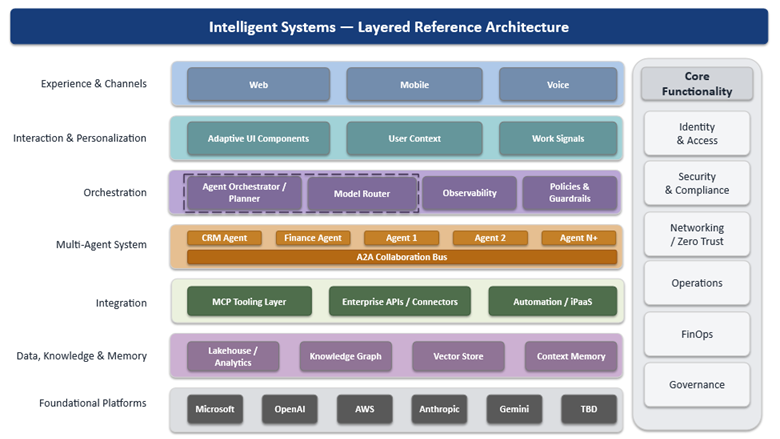
At the center of this model is a layered reference architecture that spans experience, orchestration, agent systems, integration, data, and platforms, with enterprise foundations applied across the entire stack.
Reference Architecture Diagram: Intelligent Enterprise Homepage
This architecture is not a product map. It is a way to reason about responsibilities, boundaries, and evolution as intelligent systems mature.
Several layers deserve closer attention.
The Agentic Layer: Where Intelligence Emerges
The most significant architectural shift occurs in the agentic layer.
Rather than relying on a single assistant or chatbot, intelligent systems are supported by multiple specialized agents. Some focus on specific enterprise systems. Others are more generic and can be composed dynamically based on intent.
Agents collaborate with one another through agent-to-agent communication, sharing context and outcomes as work progresses. This allows the system to address complex scenarios without relying on brittle, hard-coded workflows.
The result is a system that adapts to changing conditions while maintaining clear separation of concerns.
Orchestration as a Control Plane
Above the agents sits the orchestration layer. This layer has evolved well beyond simple coordination.
In mature architecture, orchestration is responsible for:
Planning and model routing are increasingly treated as a single concern. Model choice is no longer an implementation detail. It is a decision informed by task type, sensitivity, cost, and latency.
Policies and guardrails ensure that actions remain within enterprise boundaries, including security, compliance, data access, and financial controls. Observability closes the loop by capturing how decisions were made and how effective they were over time.
This separation of concerns is what allows intelligent systems to scale safely.
When orchestration functions as a control plane, decision logic can evolve independently of execution. Models, agents, and tools can change without rewiring the entire system. Governance remains consistent even as capabilities expand.
For enterprises, this distinction marks the difference between experimentation and sustainable scale.
Integration, Models, and Memory Working Together
Below the agentic layer, integration and model execution converge.
Rather than treating APIs, automation, and models as separate concerns, modern systems combine them into a unified execution layer. Agents invoke tools through standardized interfaces, while models are accessed through routing mechanisms governed by policy.
These capabilities depend on shared data and memory foundations. Analytical stores, knowledge graphs, vector indexes, and contextual memory provide continuity across interactions. This allows the system to reason over both enterprise data and prior outcomes.
In this model, integration is invoked selectively, not continuously.
Orchestration determines when additional context is required and which sources are relevant. Memory reduces repeated retrieval, while models are engaged only when reasoning or synthesis is needed. This selective flow keeps systems responsive without becoming brittle or unnecessarily expensive.
The result is an architecture that supports learning and adaptation while remaining operationally disciplined.
Enterprise Foundations as Cross-Cutting Concerns
Security, identity, networking, operations, and financial governance do not belong to any single layer.
They apply across the entire architecture.
Treating these capabilities as foundational ensures that intelligent behavior scales without undermining trust or control. It also aligns with how enterprises already think about platform responsibilities and risk management.
What This Changes for Enterprise Leaders
The shift toward an intelligent enterprise homepage has implications that extend beyond technology design.
For leaders, the most immediate impact is decision latency. When information is summarized, contextualized, and paired with action, decisions occur closer to the moment they are needed. Organizations spend less time assembling context and more time acting on it.
There is also a change in how expertise is leveraged. Intelligent systems reduce reliance on a small number of specialists to interpret complex data. Insight is prepared and distributed in ways that allow more people to make informed decisions with confidence.
Operating models evolve as well. Governance, security, and cost controls move earlier in the decision process rather than being applied after the fact. This reduces friction between innovation and risk management as AI systems become more autonomous.
Leadership attention shifts from managing tools to shaping intent. The focus becomes defining priorities, guardrails, and outcomes rather than directing how systems are used.
This is the deeper impact of the intelligent enterprise homepage. It does not simply change how information is accessed. It changes how decisions are made and how work is organized.
Microsoft as a Backbone, not a Boundary
For many organizations, this architecture naturally anchors on the Microsoft ecosystem. Identity, productivity, collaboration, and security already form the foundation of daily work.
At the same time, the architecture remains intentionally open. Models, tools, and services from multiple providers can be incorporated without changing its overall shape. Most enterprises will operate in mixed environments for the foreseeable future, and architectures that assume otherwise tend to fail under real-world constraints.
Emerging platform capabilities such as Azure AI Foundry and Windows AI Foundry accelerate development and governance without constraining design choices.
The result is an architecture that is Microsoft-centric while remaining extensible.
The Shift That Matters
The enterprise homepage is no longer a page.
It is becoming an intelligent operating layer that prepares work, reduces friction, and brings decisions and actions closer to the user. It coordinates agents, applies governance by design, and learns from outcomes over time.
Organizations that recognize this shift early will do more than modernize their intranet. They will change how work is structured, how decisions are made, and how technology supports people.
That is the real opportunity behind the intelligent enterprise homepage.